Spring Auction Activity Picks Up, But The Market Remains Highly Selective
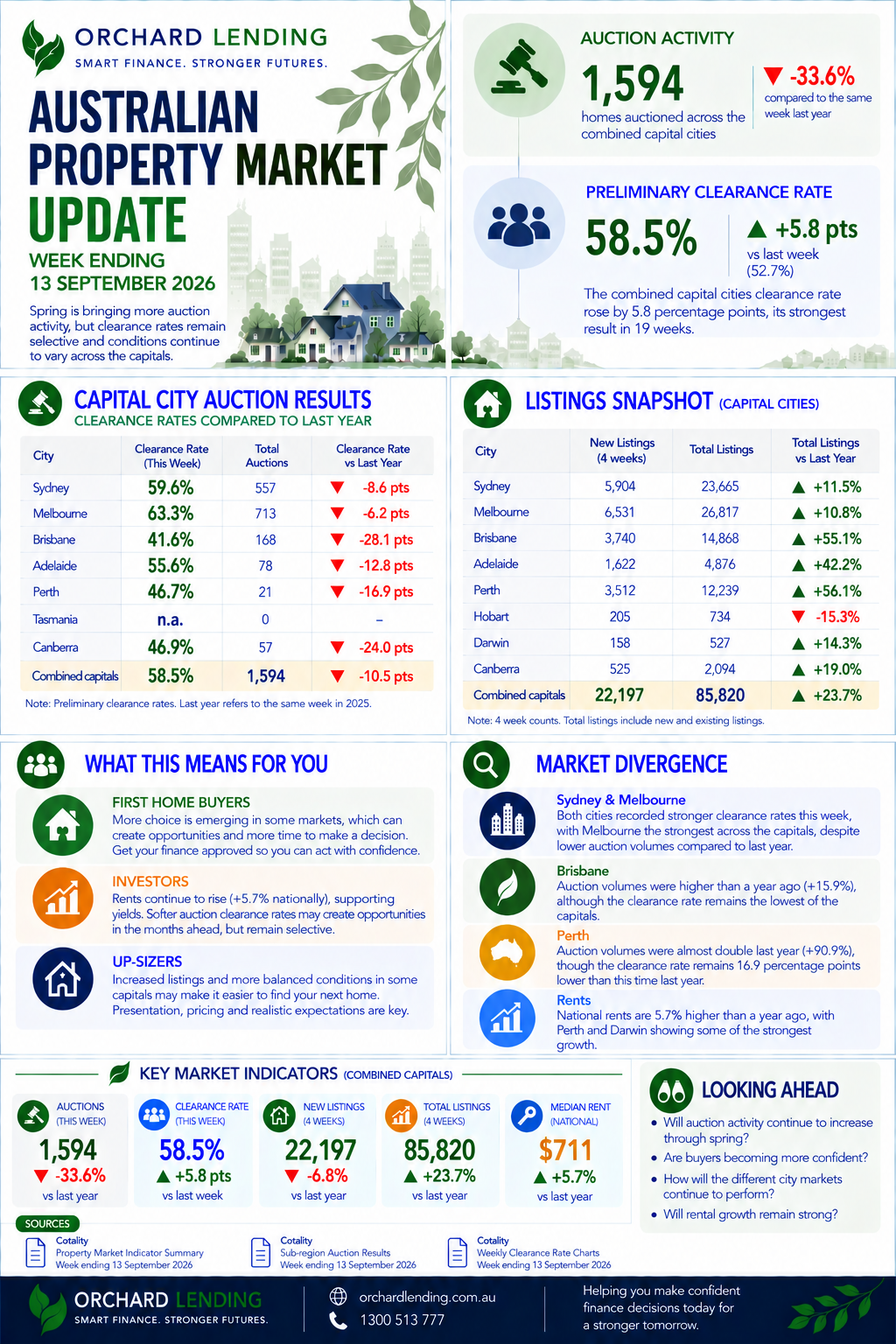
Spring is beginning to show up in the auction numbers, with activity increasing across the combined capital cities last week, although the market remains well below the levels recorded at the same time last year. A total of 1,594 homes went to auction, an 11.4% increase on the previous week but still 33.6% below the same week in 2025. The preliminary combined-capital clearance rate also strengthened to 58.5%, its highest result in 19 weeks, although it remains well below the 69.0% recorded a year ago.
Melbourne was the strongest of the major capitals, recording a 63.3% preliminary clearance rate across 713 auctions, while Sydney reached 59.6% across 557 auctions, its highest preliminary result in 19 weeks. Brisbane also improved significantly, with its clearance rate rising to 41.6%, although it remained the weakest of the capital cities. Adelaide recorded a much stronger 55.6% preliminary clearance rate, while Perth came in at 46.7%.
The broader market remains more complicated than the auction numbers alone suggest. The combined-capital Home Value Index fell 1.1% over the four weeks ending 13 September 2026, with Sydney and Melbourne continuing to record the largest short-term declines, while Brisbane, Adelaide and Perth remain positive over the year to date. At the same time, rental conditions remain relatively strong, with the national median rent sitting at $711 per week, up 5.7% over the past year.
In other words, spring is bringing more activity, but we are not yet seeing a broad-based return to the sort of buyer urgency that characterised stronger parts of the market.
What This Means For
First Home Buyers
The improvement in auction clearance rates is worth watching, but the market is still a long way from the clearance levels seen a year ago. For first home buyers, this means there may still be opportunities to negotiate, particularly where a property has been sitting on the market or where competing buyers are limited. The important point is that conditions vary substantially between cities and even between suburbs, so the national headline should not be used as a substitute for understanding the particular market being considered.
Investors
Rental growth remains one of the stronger parts of the Australian property market, with the national median rent increasing 5.7% over the past year. That provides some support to rental income, although higher borrowing costs and purchase prices still need to be considered carefully. The difference between markets is also significant, with annual rental growth of 8.0% in Perth and 11.4% in Darwin compared with 4.8% in Sydney.
For investors, the current environment is therefore less about simply finding a market with strong headline growth and more about assessing the relationship between purchase price, rental income, borrowing costs, vacancy risk and the quality of the individual property.
Up-Sizers
For up-sizers, the current market presents an interesting mix. Softer recent home-value movements can potentially reduce the price gap between an existing property and the next property, while the higher overall level of advertised stock may provide more choice in some markets.
The catch is that this does not necessarily make the move easier, because the value of both the property being sold and the property being purchased can be moving at different rates. Getting the timing and finance structure right can therefore matter just as much as the headline market direction.
Auction Clearances In Select Markets
The latest preliminary results show a considerable spread between different parts of the Australian property market. Melbourne and Sydney are currently recording the strongest major-capital clearance rates, but some individual sub-regions are producing substantially higher results.
Among the selected markets reported by Cotality, Sydney’s Outer South West recorded a 90.0% preliminary clearance rate, while Melbourne’s South East recorded 76.1%. Melbourne’s Mornington Peninsula recorded 71.4%, Melbourne’s North East 66.7%, and Melbourne’s Outer East 65.7%. At the softer end, the Gold Coast recorded a preliminary clearance rate of 36.4%, followed by the Sunshine Coast at 40.0%, Brisbane at 41.6%, Perth at 46.7% and Canberra at 46.9%.
These figures are preliminary and some individual regions have relatively small auction volumes, so they should be treated as a snapshot of current auction conditions rather than a definitive ranking of overall market performance.
Key Market Indicators
| Indicator | Latest |
|---|---|
| Capital-city auctions | 1,594 |
| Preliminary clearance rate | 58.5% |
| New listings, 4 weeks | 22,197 |
| New listings, annual change | -6.8% |
| Total listings, 4 weeks | 85,820 |
| Total listings, annual change | +23.7% |
| National median rent | $711 |
| Annual rental growth | 5.7% |
The latest listings data covers the four weeks ending 13 September 2026. New listings were 6.8% below the same period last year, while total listings were 23.7% higher. This is an interesting combination because fewer genuinely new properties are coming onto the market, while the overall amount of advertised stock remains substantially higher than a year ago.
That distinction matters. A market can have fewer new listings arriving while still carrying a much larger pool of properties that have already been advertised, which can create different conditions for buyers and sellers than simply looking at the weekly listing flow would suggest.
Questions We’re Hearing
Is the Australian property market strengthening as spring begins?
There are some early signs of increased activity, particularly in the auction market. The combined-capital clearance rate has moved up to 58.5%, its strongest result in 19 weeks, while auction volumes increased 11.4% from the previous week. However, auction volumes remain 33.6% below the same week last year, so it is too early to describe this as a broad return to the stronger conditions seen previously.
The next few weeks should provide a better indication of whether the seasonal spring increase in activity is translating into stronger and more sustained buyer demand.
Are buyers getting more choice?
The answer is a little more complicated than simply looking at new listings. New listings over the latest four weeks were 6.8% below the same period last year, but total listings were 23.7% higher. This suggests there is a larger pool of advertised stock in the market even though the flow of genuinely new properties remains below last year’s level.
For individual buyers, the amount of choice will still depend heavily on the suburb, property type and price bracket they are targeting.
Which Australian markets are performing best?
There isn’t one answer because the results differ depending on whether we look at auctions, home values, rents or listings. Melbourne currently has the strongest major-capital auction clearance rate at 63.3%, followed by Sydney at 59.6%. Meanwhile, Perth continues to record strong annual home-value growth of 14.2%, compared with 9.4% in Brisbane and 8.0% in Adelaide.
Rental conditions also vary, with annual median-rent growth ranging from 3.2% in Canberra to 11.4% in Darwin. The better question is therefore not simply which market is strongest, but which part of the market is performing differently, and why?
The Orchard Lending View
Spring has arrived, but the property market hasn’t suddenly turned into a buying frenzy.
What we are seeing instead is a market beginning to show a little more activity while remaining highly selective. The improvement in auction clearance rates is encouraging from an activity perspective, but the fact that auction volumes remain more than 30% below last year tells us that the market is still operating at a very different level to the previous spring.
There is also a growing divide between different markets. Melbourne and Sydney are producing stronger auction results, while Brisbane and Adelaide have been more mixed, and the longer-term home-value numbers continue to favour markets such as Perth, Brisbane and Adelaide over Sydney and Melbourne. That makes the national headline increasingly less useful on its own.
For buyers, this environment can provide some breathing room. A stronger auction result does not automatically mean every property is attracting multiple competing buyers, and the much higher level of total advertised stock compared with last year suggests there can still be opportunities to negotiate depending on the property and location.
For sellers, however, the message is slightly different. Buyers have more information and more choice than they did during the strongest parts of the recent cycle, meaning realistic pricing and understanding comparable sales are increasingly important. Ultimately, the Australian property market is not moving as one market. The individual property, suburb and buyer circumstances matter considerably more than the national headline.
What We’ll Be Watching Next Week
As we move further into spring, there are a few things we’ll be keeping an eye on.
Auction activity – Approximately 1,930 homes are scheduled for auction this week, so we’ll be watching whether the increase in spring activity continues and whether higher volumes are accompanied by stronger clearance rates. Cotality expects auction volumes to fall to around 1,510 the following week due to the AFL Grand Final long weekend in Victoria.
Buyer demand – The key question is whether the improvement in preliminary clearance rates represents a sustained change in buyer activity or simply a stronger week within an otherwise softer market.
Differences between markets – Sydney and Melbourne are currently producing very different results to Brisbane, Adelaide and Perth across several measures. We’ll be watching whether those gaps widen or begin to narrow as spring progresses.
Listings and rental conditions – New listings remain below last year while total listings are substantially higher, and rents continue to rise nationally. We’ll be watching whether this combination persists and what it means for buyers, sellers and investors.
Next week should give us another useful piece of the puzzle as the spring selling season gathers momentum. For now, the numbers suggest more activity, but still a selective market rather than a broad-based return to boom conditions.