Australian Rents Are Hitting an Affordability Ceiling
Australia’s rental market has been one of the strongest parts of the property market over the past few years, with rents rising sharply as population growth, smaller household sizes and a shortage of available properties have combined to put significant pressure on tenants. However, there are now growing signs that the rental market is entering a different phase, with affordability becoming an increasingly important limit on just how much further rents can rise.
This does not mean the rental market is suddenly weak, and it certainly does not mean we are about to see rents collapse. Vacancy rates remain low across much of the country and there is still a significant shortage of suitable rental housing, with Cotality reporting a national vacancy rate of around 1.7% in late 2025 and rental listings still well below historical averages.
What is changing is the amount of financial pressure being placed on tenants, with households increasingly reaching the point where another large increase in rent means changing where they live, what type of property they rent, or how much of their income they are prepared to devote to housing. In other words, Australia’s rental market may be running into something that is becoming just as important as the shortage of properties itself: the tenant’s ability to pay.
Rents Have Risen Much Faster Than Incomes
The scale of the increase in rents since the pandemic is important when looking at where the market is heading. Realestate.com.au’s rental affordability research shows national advertised rents increased from around $420 per week at the beginning of 2020 to approximately $650 per week by the end of 2025, an increase of around 55%. Over the same broad period, median household income increased by approximately 33%, meaning rents have risen considerably faster than the incomes available to pay them. Cotality’s figures tell a similar story, although the measures and time periods are slightly different.
Its latest Rental Review found national rents had increased by 40.6% over the five years to June 2026, adding approximately $204 per week to the typical household’s rental commitment. Cotality also found that rental growth had accelerated to 5.9% annually, despite the fact that affordability is already extremely stretched.
The affordability impact is significant. Cotality’s research shows households are now committing around 33% of gross median household income to rent, compared with approximately 27% five years ago. Earlier Cotality data put the figure at 33.4% of pre-tax income, compared with a decade average of 29.2%. That is a significant change in the economics of renting, because while tenants can absorb higher rents for a period of time, there is ultimately a limit to how much of a household’s income can be committed to keeping a roof over their heads.
Rental Growth Is Still Strong, But The Market Is Changing
This is where the current rental market becomes particularly interesting. It would be wrong to suggest that rental growth has simply stopped. In fact, Cotality’s June 2026 data shows national rents increased by 5.9% over the previous year, with quarterly growth of 1.6%. That is still a substantial increase, particularly given how much rents have already risen. However, it is also well below the extraordinary rental growth rates recorded during the sharpest part of the post-pandemic rental boom, when annual growth was consistently above 8%.
What appears to be changing is where the limits of rental growth are becoming visible. Domain’s June 2026 Rent Report provides a good example. Every capital city recorded a record median house rent, yet the rate of growth was very different between markets. Melbourne’s median house rent was $600 per week and had increased by only 1.7% over the year, while Sydney reached $850 with annual growth of 7.6%, Brisbane reached $700 with growth of 7.7%, and Perth reached $750 with growth of 7.1%.
Domain’s chief residential economist Nicola Powell specifically noted that signs of affordability constraints are becoming more evident, with households eventually changing their behaviour once they reach the limit of what they can absorb in rent increases. That is an important distinction because it suggests the rental shortage can remain very real while individual markets begin to run into a ceiling on how much tenants can realistically pay.
Some markets still have considerable room for further rental growth, while others appear to be reaching the point where tenants are simply running out of capacity.
Renters Are Starting To Change Their Behaviour
The important thing about an affordability ceiling is that it does not necessarily mean tenants simply refuse to pay a higher rent, instead, they start making different decisions. A tenant paying $700 per week may be prepared to accept an increase to $730, particularly if moving would involve considerable costs and inconvenience.
However, if the asking rent increases to $800 or $850, the calculation can start to change. The tenant may decide to move further from the city, choose a smaller property, move from a house into a unit, take on a housemate or look for a suburb where their existing budget provides better value. Cotality’s latest research is already showing evidence of this shift, with unit rents having outpaced house rents over the past five years.
Cotality reported that unit rents had increased by 46.9% since March 2021 compared with 39.0% for houses, with the stronger recent growth in units increasingly reflecting renters seeking more affordable options as overall rental prices remain elevated. The Rental Affordability Index tells an even clearer story. A household earning the Australian median income of approximately $124,000 could afford just 37% of rentals advertised during the second half of 2025.
That was the equal lowest level recorded since the index began in 2008. Five years earlier, a median-income household could afford approximately 60% of advertised rentals. Perhaps more importantly, that 37% figure was unchanged from the previous year because income growth was broadly offsetting further increases in rents. In other words, affordability had become so stretched that the market was beginning to rely on wage growth simply to prevent the situation from becoming even worse.
That is a substantial change in the rental market, and it helps explain why rental growth can remain positive while affordability increasingly influences tenant behaviour.
This Could Be A Problem For Some Investor Expectations
For property investors, this is an important distinction. There has been a tendency in some parts of the market to assume that strong rental growth can continue indefinitely because Australia has a shortage of rental properties. While the shortage certainly supports rents, it does not give landlords unlimited pricing power. A property investor can increase the asking rent, but ultimately the tenant’s income still has to support it.
This becomes particularly important when investors are looking at highly leveraged properties or relying on future rental growth to improve their cash flow position. If an investor purchases a property assuming rents will increase by 7% or 8% every year, but actual rental growth settles closer to 3% or 4%, the difference can have a meaningful impact on the property’s cash flow over several years.
It is also worth remembering that higher interest rates, insurance, land tax, maintenance and other ownership costs do not automatically translate into higher achievable rents. The landlord’s costs and the tenant’s ability to pay are two separate things, and the market ultimately determines what a property can be rented for. This is where I think the next stage of the rental market could become more interesting for investors. Rather than simply asking whether rents are rising, investors may need to pay much closer attention to the relationship between the rent they are achieving, the local income levels and the affordability of competing properties.
In a market where tenants are becoming increasingly price-sensitive, the property that provides good value for its location and quality may ultimately have a stronger rental outlook than simply assuming every property in the area will achieve the same percentage increase.
The Rental Market Is Becoming More Uneven
The national numbers also hide some significant differences between individual cities. Domain’s June 2026 data showed Sydney remained Australia’s most expensive capital city for house rents at $850 per week, while Melbourne was at $600, Brisbane at $700, Adelaide at $650 and Perth at $750. However, the rate at which those rents were increasing was very different.
| Capital City | Median House Rent | Annual Change |
|---|---|---|
| Sydney | $850 | 7.6% |
| Melbourne | $600 | 1.7% |
| Brisbane | $700 | 7.7% |
| Adelaide | $650 | 4.8% |
| Perth | $750 | 7.1% |
| Canberra | $710 | 2.9% |
| Darwin | $760 | 11.8% |
| Hobart | $625 | 7.8% |
| Combined Capitals | $700 | 7.7% |
Source: Domain Rent Report, June 2026.
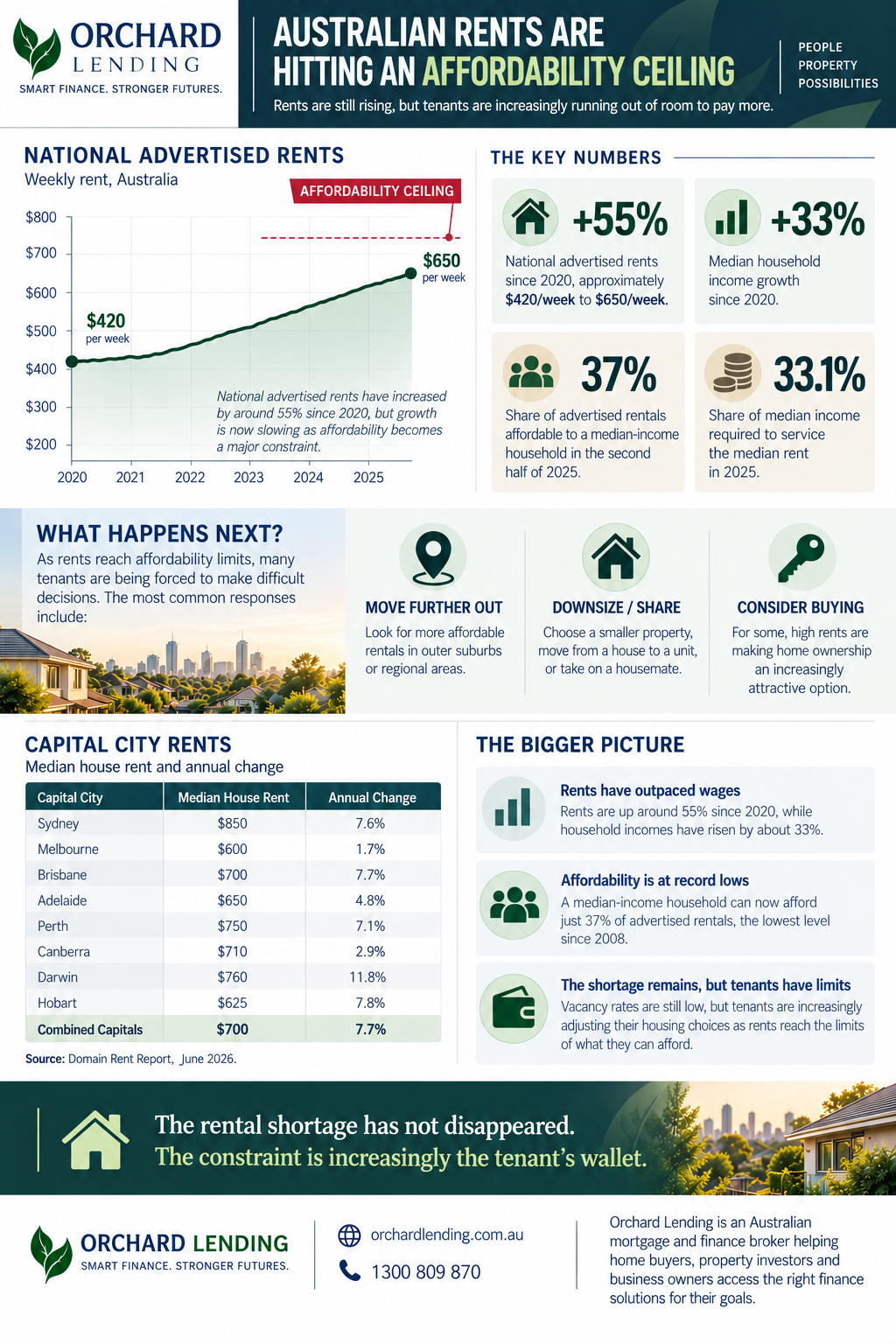
Melbourne is particularly interesting because it has gone from being one of Australia’s most expensive rental markets to the cheapest capital city for house rents, although describing Melbourne as “cheap” would obviously be stretching the definition when the median house rent is still $600 per week. The more important point is what has happened to rental growth.
Melbourne’s annual increase of just 1.7% is dramatically below the 7.6% recorded in Sydney and the 7.7% recorded in Brisbane, suggesting that tenants and landlords are operating in very different conditions depending on the city. Domain’s research also provides a useful illustration of what an affordability ceiling can look like in practice. Melbourne’s rents have reached record levels, but the combination of greater rental supply and more price-sensitive tenants appears to be limiting how quickly landlords can continue pushing rents higher.
That does not necessarily mean Melbourne is an isolated example. As rents continue to rise in other cities, it is reasonable to expect more markets and more individual suburbs to eventually encounter similar constraints.
So Have Rents Peaked?
I don’t think the evidence supports saying that Australian rents have peaked nationally. The rental market remains undersupplied, population growth continues to create demand and there are still plenty of markets where tenants are competing for a relatively small number of properties. Cotality’s latest data shows national rents are still increasing at 5.9% annually, while vacancy rates remain tight and the supply of rental listings remains well below historical averages.
What I do think is becoming increasingly difficult to argue is that rents can continue increasing at the extraordinary rates we saw during the strongest part of the post-pandemic rental boom without eventually running into affordability constraints. The numbers are already telling us that this process has started. Rents have risen much faster than incomes, rental affordability has fallen to record lows and tenants are increasingly being forced to adjust their housing choices.
At the same time, rental growth has moderated significantly from the extraordinary levels seen earlier in the decade, even though it has recently begun to accelerate again. This creates an unusual situation where the rental market can remain very tight while affordability increasingly determines how far individual rents can go which may ultimately be the story of the next few years.
What Does This Mean For Investors?
For investors, I think the message is less about being bearish or bullish on property and more about being realistic about the assumptions being used when assessing an investment. A property purchased today should ideally make sense based on today’s numbers rather than requiring several years of aggressive rental growth to make the investment work.
Rental growth should certainly be considered, but assuming that rents will continue rising by 7%, 8% or 10% every year could become increasingly difficult to justify in markets where tenants are already allocating a very large proportion of their income to housing.
The other consideration is that rental affordability is likely to create greater differences between individual properties. A well-located property in an area where the rent remains relatively affordable compared with local incomes may continue to perform strongly, while properties already sitting at the upper end of what tenants can reasonably afford may find it harder to achieve another large increase.
For investors, this means the old question of “What rent can I get?” is becoming a little more complicated. The better question may be “What rent can I get, and how affordable is that rent for the type of tenant who lives in this property?” That is a much more useful question when assessing the sustainability of rental income.
Rent vs Buying: The Affordability Paradox
There is an interesting paradox developing here for renters, because as rents become increasingly expensive, the argument for buying a property can actually become stronger for some households, even though higher property prices and borrowing costs can make entering the market more difficult.
A renter paying $700 or $800 per week is already committing a substantial amount of their income to housing, so the question becomes whether continuing to rent provides better financial value than using a similar amount of money to service a mortgage and build equity, particularly when rent is expected to continue increasing over time.
Of course, this is not as simple as comparing the weekly rent with a mortgage repayment, because home ownership comes with interest, rates, insurance, maintenance, transaction costs and the opportunity cost of the deposit, while renting provides flexibility and allows the renter to invest or save the difference. The answer can therefore be very different depending on the property price, interest rate, deposit, expected property growth and future rental increases.
We will look at this in more detail in a separate article, where we will work through the numbers and look at the rent-versus-buying question over time, including the point at which buying may begin to financially outperform renting and when renting can still make more sense.
The Bottom Line
Australia’s rental shortage has not disappeared, and I don’t think we are suddenly heading towards a period of falling rents across the country.
What appears to be changing is the amount of room available for further rental increases before tenants begin changing their behaviour. In some markets, particularly those where rental supply is relatively better or rents have already reached very high levels compared with local incomes, that constraint is already becoming visible. In other markets, the shortage remains severe enough to continue pushing rents higher.
For investors, this means rental growth is likely to remain an important part of the property story, but it may be unwise to assume that the extraordinary rental increases of the past few years can simply continue indefinitely.
The next phase of the rental market may be less about a national boom or bust and more about affordability, local supply and the individual characteristics of each property. The shortage of rental housing remains very real, but the tenant still needs to be able to afford the property being offered.
The question is increasingly becoming not whether they will pay more, but how much more they can realistically afford before they change where and how they live.