Spring is normally when Australia’s property market starts to wake up.
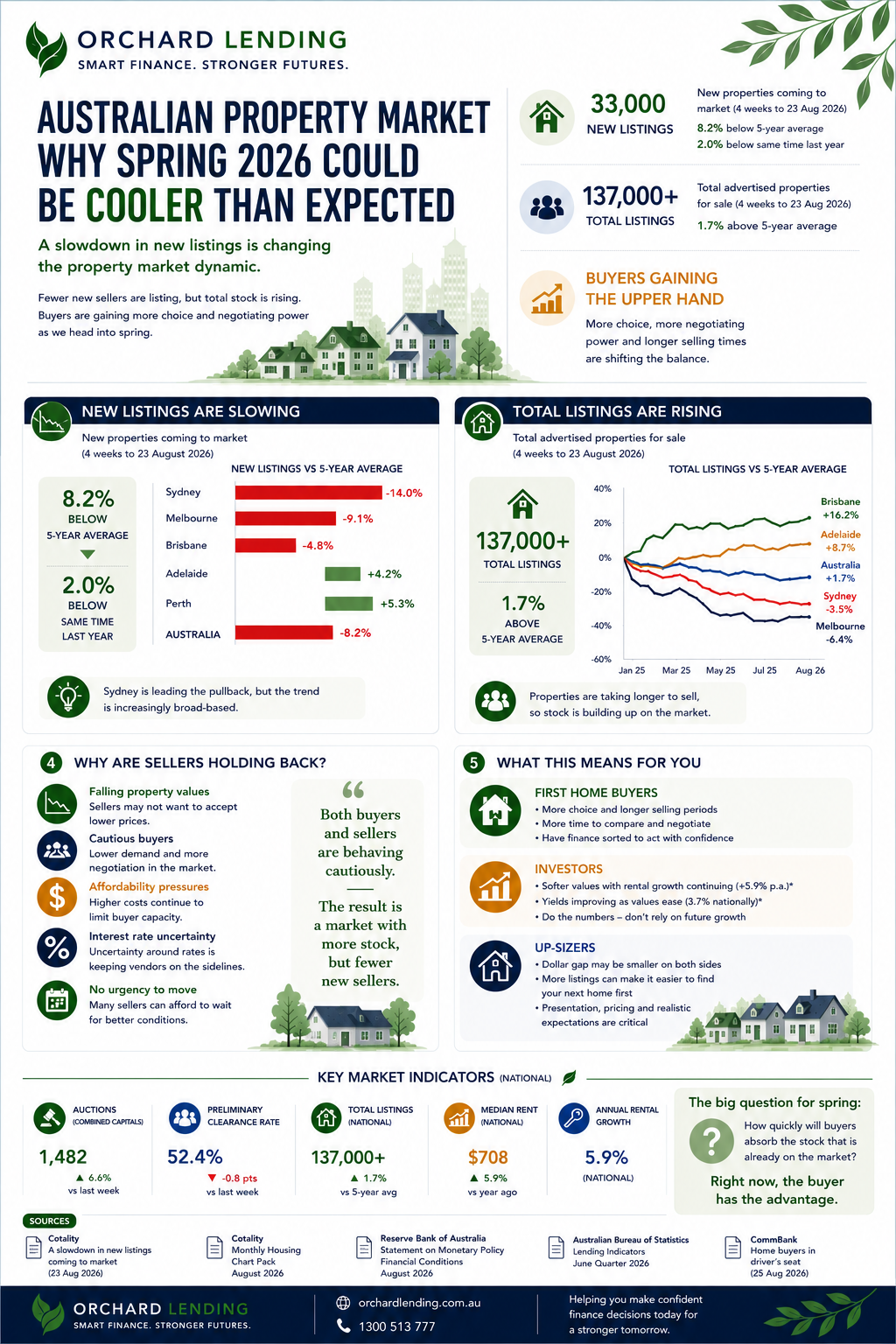
The weather improves, auction activity increases, vendors decide it is time to sell and buyers who have been waiting through winter start looking more seriously. Over the past five years, Cotality says the number of new property listings nationally has typically increased by almost 25% between the end of August and the middle of November. But 2026 is shaping up differently, with the latest Cotality listings data shows 33,000 new properties came onto the market in the four weeks to 23 August, which was 8.2% below the five-year average and 2.0% below the same period last year. At the same time, total advertised stock had climbed to more than 137,000 properties, 1.7% above the five-year average.
That combination is fascinating; Fewer new properties are being listed while the total number of properties available for sale is increasing. For buyers, that can mean more choice and greater negotiating power. For sellers, it potentially means a much more difficult decision about whether to sell now or wait.
1. What’s happening with new property listings?
The first part of the story is the slowdown in new listings, with Cotality’s data shows new listings were broadly around their five-year average between February and early June. Since June, however, the flow of new properties coming onto the market has faded.
In the four weeks to 23 August, new listings were:
- 8.2% below the five-year average nationally
- 2.0% below the same period in 2025
- 14% below average in Sydney
- More than 9% below average in Melbourne
- Almost 5% below average in Brisbane
- Around 4% above average in Adelaide
Sydney is therefore leading the pullback, although the trend is increasingly broad-based. This is important because falling listings don’t necessarily mean sellers are confident, and as report in our Sydney August Property Update. In this case, the opposite appears to be happening, in that potential vendors are looking at softer property values, whilst fewer buyers and greater uncertainty around interest rates and deciding that now may not be the ideal time to sell.
2. But total listings are actually rising
This is where the story gets more interesting. If fewer properties are coming onto the market, you might expect the total amount of property available for sale to fall but it hasn’t trended this way so far. Cotality recorded more than 137,000 properties listed for sale nationally in the four weeks to 23 August being 1.7% above the five-year average; Back in mid-January, total listings were almost 26% below average. The simplest explanation is that properties are taking longer to sell and revelaing that when demand falls, but properties continue to come onto the market, unsold stock starts accumulating.
That changes the balance of power: A buyer who previously had to make an offer quickly because another five people were interested may now be looking at three or four comparable properties that have been sitting there for weeks, and that is a very different buying environment.
3. Buyers are getting more negotiating power
This may be the biggest takeaway from the latest data. Cotality says elevated stock levels in Sydney and Melbourne are already providing buyers with more choice and greater ability to negotiate around price and the shift has also become particularly noticeable in the mid-sized capitals. Brisbane is a good example whereby In the four weeks to 11 January, Brisbane’s total listings were around 43% below the five-year average. By the four weeks to 23 August, they were more than 16% above average, substantially reversing the trend. It doesn’t necessarily mean Brisbane property is suddenly oversupplied but it does mean the conditions buyers are facing are very different from earlier in the year.
This is where the distinction between “prices are falling” and “buyers have negotiating power” becomes important. A buyer might not get a 10% discount simply because the market has softened, but they may have more time and more properties to compare and less competition from other buyers. Ultimately this turns from fear of missing out, to fear of jumping too soon.
4. Why are sellers holding back?
There are several reasons potential vendors may be choosing to wait with the most obvious being price. If an owner believes their property could have sold for significantly more six months ago, they may not want to crystallise today’s lower valuation, and there is also the question of what happens after the sale. If someone sells their current home but then has to buy another property in the same market, falling prices can work both ways; Selling for less isn’t necessarily a disaster if the property they’re buying has also fallen in value at the same time. But if someone is selling purely to exit the market, refinance investment mortgage debt or move interstate, the decision can be more complicated.
Cotality points to falling values, cautious buyers, affordability constraints and uncertainty around interest rates as factors contributing to the slowdown in vendor activity. The Reserve Bank’s latest assessment adds another piece to the puzzle. Its August Statement on Monetary Policy says financial conditions have tightened following rate increases earlier in 2026, scheduled mortgage payments have risen relative to household disposable income, and established housing-market conditions have softened more than previously expected. That helps explain why both buyers and sellers are behaving cautiously.
5. What does this mean for the spring selling season?
This is where I think the Cotality data becomes particularly interesting. Historically, Spring brings a large increase in new listings, and analysis show that over the past five years new listings have increased by almost 25% between the end of August and the middle of November. But what happens if vendors don’t follow the usual seasonal pattern? We could end up with a spring market where:
More properties are available than last year…
but
fewer new properties are actually being added.
That sounds contradictory, but it makes sense when you consider how long properties are taking to sell. The key question for the next few months is therefore not simply: “How many properties are listed?” It is “How quickly are those properties being absorbed by buyers?” If listings continue to accumulate and clearance rates remain subdued, buyers could gain even more leverage. If buyers suddenly return and absorb the available stock, the dynamic could change quite quickly.
6. Sydney and Melbourne are already showing the change
Sydney is arguably the clearest example as new listings were more than 14% below the five-year average in the four weeks to 23 August, Melbourne was more than 9% below average. At the same time, both cities have experienced significant falls from their recent peaks. Cotality’s August Housing Chart Pack shows Sydney and Melbourne already more than 5% below their respective peaks. Cotality also notes that Melbourne has a much smaller buffer of accumulated growth than Perth, Brisbane or Adelaide. That creates a very different environment from the boom conditions we’ve become accustomed to. The seller can’t simply assume:
“If I wait another month, someone will probably pay more.”
And the buyer doesn’t necessarily need to think:
“If I don’t buy today, it’ll be 5% more expensive next month.”
Both sides have more reason to pause.
7. Brisbane tells a different story
Brisbane is particularly interesting because it has come from a much stronger growth cycle, and still retains a substantial buffer from its recent growth, even after the recent downturn began. Modelling suggests that even a hypothetical 20% decline from peak would only take Brisbane’s values back to around August 2024 levels; importantly, this is a scenario rather than a forecast. At the same time, Brisbane’s advertised stock has increased dramatically relative to its five-year average. This doesn’t necessarily mean Brisbane is heading for a major collapse, it means the market is normalising from an exceptionally strong period of growth.
8. What about Perth and Adelaide?
The mid-sized capitals are particularly useful when looking at this market because their starting points are different, with Perth, Brisbane and Adelaide also experiencing very strong growth over the preceding five years. As a result, they have considerably more accumulated growth to absorb if conditions soften. Further analysis shows that even a hypothetical 20% decline would leave Perth around April 2025 values, and Adelaide around April 2024 values, exampling stress scenarios, not predictions.
Adelaide is also behaving differently from Sydney and Melbourne when it comes to new listings, with new listings still around 4% above the five-year average in the four weeks to 23 August. So while we talk about an Australian housing market, the reality remains, Australia has multiple property markets moving through different stages of the cycle.
9. What does this mean for investors?
This is where the story gets particularly nuanced. Falling property values aren’t necessarily bad for investors if rental income remains strong and the purchase price becomes more attractive. Annual rental growth remained at 5.9% in July, while gross rental yields increased to 3.7% nationally as values softened, a natural construct of falling prices against rising rents. But investors are also dealing with tighter financial conditions, as the ABS reported that the number of new investor dwelling-loan commitments fell 8.6% in the June quarter, while the value of investor commitments fell 10.2%. That suggests investors aren’t simply rushing back into the market just because prices have softened, with additional holding cost increases, and potential impact of budget changes further adding to decision points.
For an investor, the equation remains: Purchase price + borrowing cost + expenses to be considered against rental income & future prospects and against other opportunities.
A cheaper property isn’t automatically a better investment but a market with less competition can create opportunities to buy a good property at a more sensible price.
10. What does this mean for first home buyers?
For first home buyers, this could be one of the more interesting spring markets we’ve seen for some time. The biggest advantage isn’t necessarily falling prices but time. If a property has been sitting on the market for several weeks, buyers can inspect it properly, compare it with alternatives and negotiate without necessarily feeling that someone else will snap it up tomorrow, and favourable conditions in the contract. That doesn’t mean every vendor will negotiate, but there is more leverage on the buyer’s side, though the best properties in tightly held locations can still attract competition.
But the broader environment is increasingly giving prepared buyers something that has been in short supply during stronger markets: choice
11. What does this mean for sellers?
This is probably the side of the market that deserves more attention as a seller entering spring 2026 shouldn’t necessarily assume that the usual spring uplift will do the heavy lifting. There may be more buyers around than during winter, but those buyers are also likely to have more choice, and that makes pricing, presentation and realistic expectations increasingly important. The data suggests vendors who don’t need to sell may choose to wait, and for those who do need to sell, the market is telling them something fairly clearly:
The buyer has more leverage than the sellers did during the boom. Trying to price a property based on what the neighbour achieved six months ago may not produce the same result today, though buyers also need to understand there are still pockets of high demand that will wether the down-turn well.
12. So, is this actually good news for buyers?
Potentially, yes. Cotality’s conclusion is quite direct: buyers who have the confidence to transact in the current environment may have an opportunity because they face less competition, lower housing values and greater negotiating leverage. A softer market though, doesn’t mean every property is suddenly cheap, as mentioned in the point above; A great property in a tightly held suburb can still be expensive.
What has changed is the process of buying. There may be more opportunity to negotiate, and more opportunity to compare, added with more opportunity to walk away. All this potentially allowing more opportunity to find a property that works rather than buying simply because you’re worried about missing out.
13. The bigger question: what happens next?
This is the part I’m most interested in watching over the next few months, and there are two competing forces now operating in the market. Supply is pushing one way with more properties sitting on the market, giving buyers more choice. Vendor behaviour is pushing the other with ewer new sellers choosing to list, which limits the flow of fresh stock. If buyer demand stays weak, total listings could continue to build even without a major increase in new listings or If buyer confidence improves, that stock could start clearing more quickly. And if interest-rate expectations change materially, the equation could shift again.
The RBA’s August assessment noted that established housing-market conditions had softened more than expected and that demand for new housing loans had declined noticeably, while financial conditions remained restrictive. So I don’t think the most useful question right now is:
“Are Australian property prices going up or down?”
It is:
“Who has the negotiating power, and how long does that last?”
What This Means For
First Home Buyers
This could be a more comfortable market to enter than the recent boom conditions. More stock and longer selling periods can provide additional time to compare properties and negotiate. The key is still having mortgage finance sorted before starting the search so that you can act when the right property appears.
Investors
The combination of softer values and continued rental growth is worth watching, particularly in markets where yields are improving. But higher borrowing costs and changing investor demand mean the numbers need to work on their own merits rather than relying on a future capital-growth story.
Up-Sizers
A softer market can potentially reduce the dollar gap between an existing home and the next property, particularly where both ends of the market have adjusted. More listings may also make it easier to find the right next home before committing to a sale.
Questions We’re Hearing
Why are property listings falling if there are more properties for sale?
Because new listings and total listings measure different things. New listings measure properties newly coming onto the market, while total listings include properties that have already been advertised but haven’t sold. If properties take longer to sell, total listings can rise even while fewer new properties are being added.
Is spring usually a good time to sell property?
Historically, spring brings a significant increase in listings and buyer activity. Cotality estimates new listings have increased by almost 25% between late August and mid-November over the past five years. The question in 2026 is whether vendors will respond in the same way given weaker prices and buyer demand.
Are buyers really in control of the market?
The evidence increasingly points in that direction, particularly in Sydney and Melbourne. Higher total listings, longer selling periods and weaker auction clearance rates can give buyers more choice and negotiating power. However, individual suburbs and property types can behave very differently.
Could fewer listings actually support property prices?
Potentially. If enough vendors hold back, the reduction in fresh supply could eventually help stabilise prices if buyer demand improves. That’s one reason why the next few months will be particularly interesting.
The Orchard Lending View
I think this is one of the more interesting property-market stories heading into spring.
We often talk about supply and demand as though they’re two fixed numbers. They’re not. Sellers can decide not to sell whilst Buyers can decide not to buy.
And right now, both sides are showing signs of caution. The result is a market where total stock is increasing, but the flow of new properties is slowing. That is giving buyers more leverage without necessarily creating the huge oversupply that some people might assume when they see listings rising. For buyers who are financially ready, I think that’s potentially a pretty useful environment. Not because property is suddenly cheap or because prices can’t fall further, but because you can negotiate again. And after several years where buyers in many parts of Australia have had to compete hard simply to secure a property, having a little more time and leverage is a meaningful change.The next few months will tell us whether this is simply a cooler spring, or the beginning of a much more significant shift in the way Australia’s property market operates.