Three Years Later, the US Just Raised Rates. What Does It Mean for Australia?
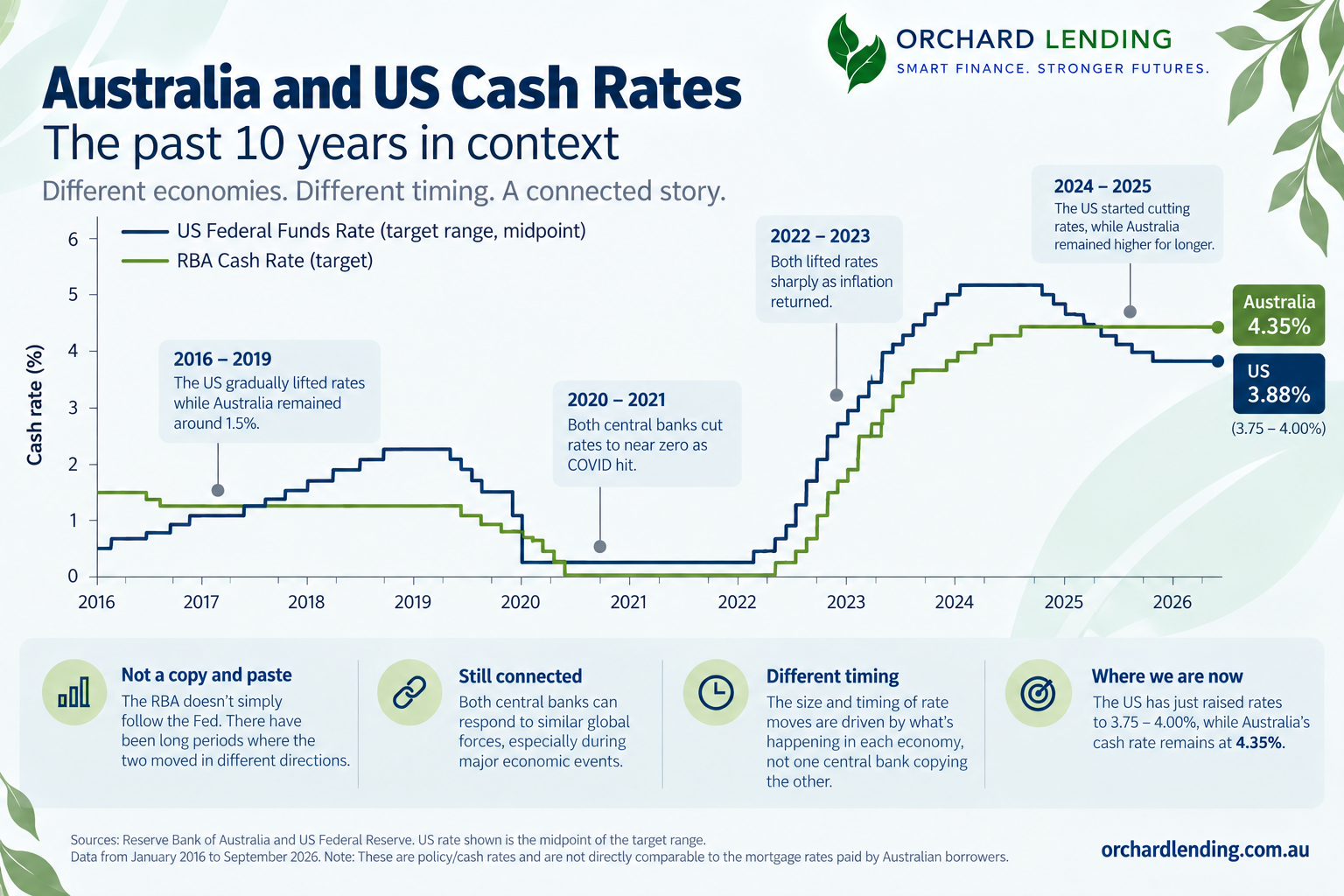
For the first time in more than three years, the US Federal Reserve has raised interest rates. On Wednesday, the Fed increased its federal funds target by 0.25 percentage points to a range of 3.75% to 4.00%, with the decision reflecting continued concerns about inflation despite reasonably solid economic growth. The Fed said economic activity remained firm, productivity and investment were strong, and inflation was still elevated enough to warrant further tightening.
For Australians, the obvious question is whether this means Australian interest rates are about to head higher as well.
The short answer is not necessarily.
The RBA does not simply look across the Pacific, see what the Fed has done and decide that it probably ought to do the same thing. Australian interest rates are set according to Australian economic conditions, particularly inflation, employment, household spending and the broader state of the economy. However, that does not mean what happens in the US is irrelevant to us. Far from it.
The global financial system is a fairly interconnected machine, and changes in US interest rates can eventually work their way into Australian borrowing costs, the Australian dollar, financial markets and ultimately the property market. This is where things get a little more interesting.
What Just Happened?
The Federal Reserve has raised its benchmark interest rate by 25 basis points, taking the target range to 3.75% to 4.00%. It is the first US rate increase since July 2023, and the decision comes at a time when inflation remains above the Fed’s 2% target. The Fed’s latest projections also indicate that policymakers see the possibility of another increase before the end of 2026, although future decisions will depend on how the economy and inflation develop.
The interesting part for Australia is not necessarily the 0.25% increase itself. One quarter of a percentage point is relatively small in isolation, and Australian borrowers are not suddenly going to receive a letter from their bank because the Fed changed its rate yesterday.
What matters more is why rates are rising and what financial markets do in response.
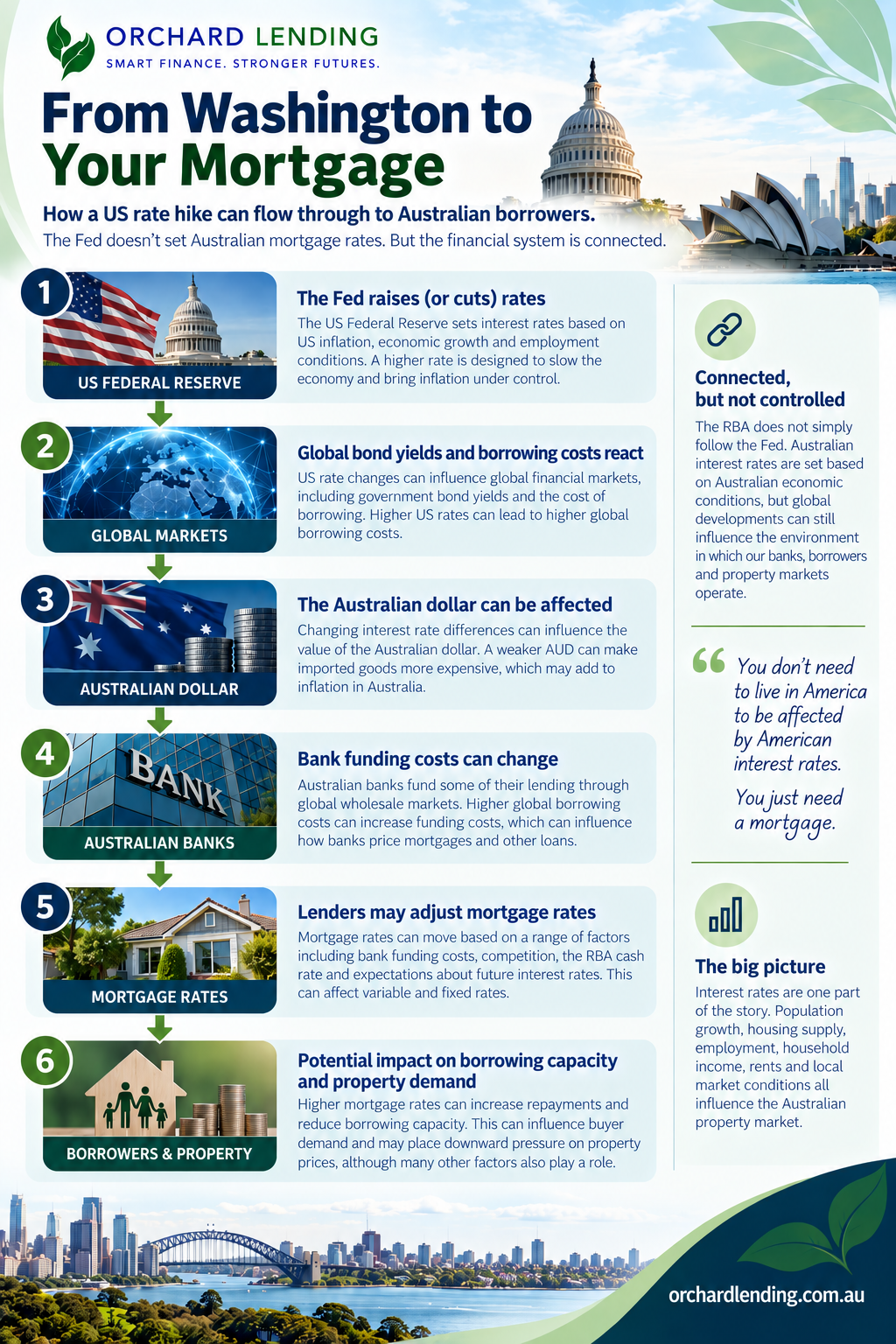
When the world’s largest economy has stronger-than-expected growth and persistent inflation, investors can start expecting interest rates to remain higher for longer. That can influence government bond yields and other borrowing costs around the world. US government bond yields are particularly important because they sit near the foundation of global financial markets, so movements in the US can influence the cost of money elsewhere even when another country’s central bank is doing something completely different.
That is the first important distinction to make.
The Fed sets US monetary policy. It does not set Australian interest rates, but its decisions can influence the financial conditions in which Australian banks, businesses and households operate.
The RBA Doesn’t Have to Follow the Fed
It is tempting to think that if the US raises rates, Australia eventually has to raise rates as well. It sounds logical, but monetary policy doesn’t quite work that neatly. The RBA is setting interest rates for the Australian economy. If Australian inflation is falling, employment is weakening and household spending is slowing, the RBA could decide that higher Australian interest rates are not appropriate even if the Fed is tightening.
The reverse is also true. If inflation in Australia remains too high or domestic demand proves stronger than expected, the RBA could raise rates even if the Fed is holding steady. There is another factor as well, and this is where exchange rates become important.
If US interest rates rise relative to Australian rates, the difference between the returns available in the two countries can change. That can influence international capital flows and the Australian dollar. A weaker Australian dollar can make imported goods and some other costs more expensive, which can feed into Australian inflation.
The RBA has previously highlighted several ways that US financial conditions can affect Australia, including global bond yields, exchange rates, asset prices, offshore funding and trade.
So there is a connection, but it is not a simple Fed up = RBA up equation.
How Interest Rates Flow Through to Australian Borrowers
| Interest Rate | What It Represents | What It Influences | How Directly It Affects Borrowers |
|---|---|---|---|
| RBA Cash Rate | The RBA’s target for the overnight cash market | Variable lending and deposit rates | High |
| Bank Funding Costs | What banks pay to obtain the money they lend | Mortgage and business loan pricing | High, but indirect |
| Wholesale / Bond Yields | Market pricing for longer-term borrowing | Bank funding costs and fixed-rate pricing | Indirect |
| Mortgage Rates | The actual rate charged to borrowers | Repayments and borrowing capacity | Direct |
The important point is that these rates are connected, but they are not interchangeable. The RBA cash rate is the starting point for monetary policy, but banks still have to fund the loans they provide and price those loans according to their own costs, competition and expectations about future interest rates. This is why a movement in global bond yields can matter to Australian borrowers without the RBA necessarily changing the cash rate at exactly the same time.
Australian Mortgage Rates Don’t Only Depend on the RBA Cash Rate
This is probably the most important part of the story for Australian borrowers. When we talk about interest rates, we often focus almost entirely on the RBA cash rate because that is the number we hear about every month. And it is certainly important. The cash rate influences other interest rates throughout the economy, including mortgage rates and deposit rates.
But Australian banks don’t simply take the RBA cash rate, add a fixed margin and send everyone their new mortgage rate.
Banks have to fund the money they lend. Some of that funding comes from deposits, while some comes from wholesale debt markets and other sources. The cost of that funding can move for reasons beyond the RBA’s immediate decision. The RBA noted in its August 2026 Statement on Monetary Policy that major bank funding costs had increased by an estimated 18 basis points since May as higher cash rates flowed through to deposit and wholesale debt rates.
At the same time, competition between lenders had kept the spreads between lending rates and the cash rate relatively low. This is why looking only at the RBA cash rate can sometimes give you an incomplete picture. Think of the cash rate as one important part of the plumbing rather than the entire plumbing system.
If global borrowing costs rise, Australian banks can face higher funding costs even if the RBA is sitting still. That does not mean Australian mortgage rates automatically rise every time US bond yields move higher, because banks are also competing for customers and have other sources of funding. But it does mean there are pathways through which international financial conditions can eventually affect Australian borrowers.
And that brings us to the more interesting question……
Could Australian Mortgage Rates Rise Even If the RBA Doesn’t Move?
Yes, they could.
That doesn’t mean they necessarily will, but it is entirely possible for Australian mortgage pricing to change without the RBA changing the cash rate. The reason is that lenders price mortgages according to their own funding costs, capital requirements, competition and expectations about future interest rates. The RBA cash rate is a major influence, but it is not the only variable in the equation.
This is also why fixed mortgage rates can sometimes move before the RBA has actually made a decision. Banks and lenders are looking forward, not simply reacting to yesterday’s cash rate. The same principle applies in reverse. If global markets become more comfortable that inflation is coming under control and longer-term borrowing costs fall, lenders may have room to reduce some mortgage rates even if the RBA itself hasn’t yet changed the cash rate.
So when we hear that the Fed has raised rates, the question for an Australian borrower isn’t really:
“Will the RBA copy the Fed?”
It is more useful to ask:
“What happens to global borrowing costs, the Australian dollar, Australian inflation and bank funding costs as a result?”
Those are the transmission channels that matter.
So What Happens From Here?
There are a few different ways this could play out, and they don’t all lead to higher Australian mortgage rates.
Scenario 1: The US Rate Hike Is Largely Contained
The Fed raises rates, US inflation gradually improves, financial markets absorb the move and longer-term borrowing costs remain relatively stable. If that happens, the direct effect on Australia could be fairly limited.
The RBA can continue focusing on Australian conditions rather than feeling compelled to respond simply because the Fed moved.
This is entirely possible because central banks are ultimately dealing with different economies.
Scenario 2: Global Borrowing Costs Move Higher
The more important scenario for Australian borrowers would be a broader rise in global bond yields and wholesale funding costs.
If investors begin to believe that inflation will remain elevated for longer, they may demand higher yields on government bonds and other forms of debt. That can increase the cost of borrowing across financial markets, including for banks.
This is where the US rate decision could matter even without an immediate change in the Australian cash rate. The RBA has already pointed out that Australian financial conditions are influenced by global developments, and that US economic resilience and persistent inflation have contributed to expectations of a higher US policy rate path.
Scenario 3: The Australian Dollar Falls and Inflation Becomes a Bigger Issue
There is another possible pathway through the exchange rate.
If US interest rates rise relative to Australian rates, the Australian dollar can come under pressure. A weaker dollar makes some imported goods and inputs more expensive in Australian dollars.
That doesn’t automatically create a major inflation problem, but if inflation is already proving stubborn, it can make the RBA’s job more difficult.
And this is where the US and Australia can become connected without the RBA ever explicitly deciding to respond to the Fed. The RBA isn’t raising rates because the Fed raised rates. It may instead respond to the effect that changing global financial conditions are having on Australia.
There is a fairly important distinction between the two.
What Could This Mean for Australian Property?
This is where we eventually get back to the thing most Australians are actually interested in.
Property.
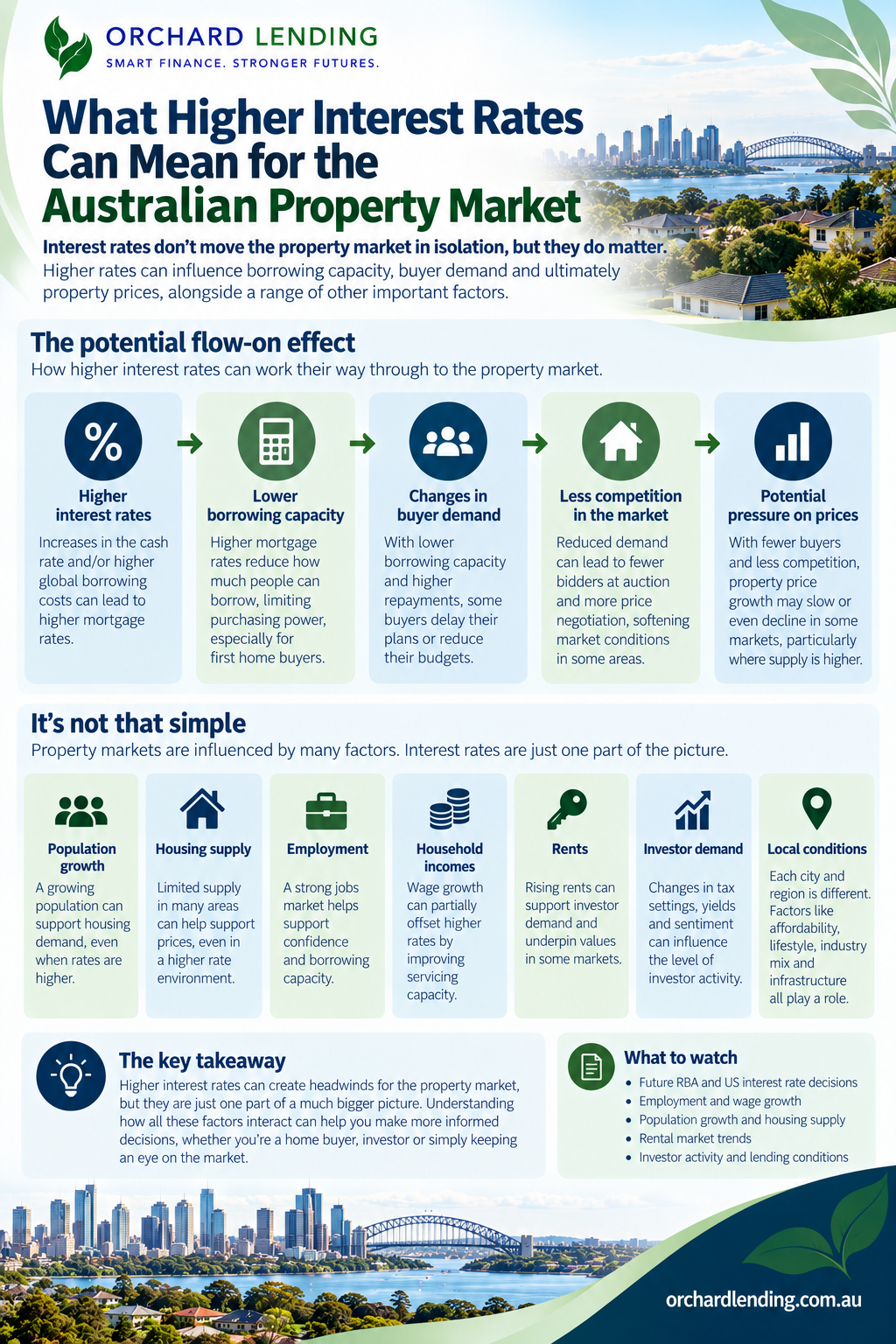
Interest rates matter because they affect borrowing capacity and household cash flow. If mortgage rates rise, even modestly, the amount a household can comfortably borrow can fall. That can reduce the pool of buyers able to pay higher prices, particularly at the more heavily leveraged end of the market. But the relationship isn’t as simple as rates up = property prices down.
The Australian property market has many other moving parts. Employment, population growth, housing supply, household income, rents, investor activity, lending policy and the amount of stock available for sale can all influence market conditions. This is particularly important at the moment because the Australian housing market is already showing quite different conditions between cities.
The latest Cotality data, for example, shows the combined-capital Home Value Index has softened over the most recent four weeks, while markets such as Perth, Brisbane and Adelaide have continued to record stronger annual growth than Sydney and Melbourne. Rental growth also remains positive nationally, with the median rent sitting at $711 per week.
So an additional change in borrowing costs would not necessarily affect every Australian property market in the same way.
The Australian Property Market Doesn’t Move as One Market
This is something we have been talking about regularly in the weekly property updates, and it becomes even more relevant when looking at interest rates. Sydney isn’t Perth. Perth isn’t Melbourne. Melbourne isn’t Brisbane.
Different markets have different levels of supply, population growth, employment conditions, affordability and investor activity. Even within a single city, different suburbs and property types can behave very differently. That means the impact of higher global borrowing costs could also be uneven.
A highly leveraged market where affordability is already stretched may respond differently to a change in mortgage rates than a market where property prices are lower, rental growth is stronger and household debt is less of a constraint. This is why I think it is worth being careful with headlines suggesting that one change in US interest rates tells us what Australian property prices will do next.
It doesn’t. It is one piece of the puzzle.
What Should Borrowers Actually Be Watching?
Rather than becoming overly focused on every move by the Federal Reserve, Australian borrowers would probably get more useful information by watching several things together.
- Australian inflation remains important because it directly influences what the RBA does with the cash rate.
- The RBA’s own interest-rate decisions and commentary obviously matter because that is the monetary policy setting that directly affects Australian borrowing conditions.
- Mortgage rates from Australian lenders are also worth watching independently of the cash rate. Competition between banks can sometimes produce changes in mortgage pricing that aren’t perfectly aligned with the RBA’s movements.
- Global bond yields and borrowing costs matter because they influence the cost of funding in financial markets, including the markets Australian banks use.
- The Australian dollar is another piece of the puzzle, particularly if movements in the currency begin feeding through into imported inflation.
And then there are the things happening in the real economy: employment, household spending, housing credit, property prices, rents and listings.
Ultimately, those are the numbers that tell us whether the financial conditions are actually changing the behaviour of Australian households.
The Big Takeaway
The US has just raised interest rates for the first time in more than three years, and it is reasonable for Australian borrowers and property owners to pay attention. But there is no automatic chain reaction where the Fed raises rates, the RBA follows, Australian mortgage rates rise and property prices fall. The reality is considerably more interesting. US interest rates can influence global borrowing costs, bond yields, exchange rates, financial markets and the cost of funding for banks.
Those changes can then flow into Australia, sometimes quite gradually and sometimes through channels that aren’t immediately obvious. At the same time, the RBA remains focused on the Australian economy. Its decisions will continue to be driven primarily by domestic inflation, employment, household spending and financial conditions rather than simply copying whatever the Fed has done.
For Australian borrowers, the important thing is therefore not to obsess over the US rate decision in isolation. Watch what happens next.
If global borrowing costs remain contained, the Australian impact could be relatively limited. If global yields move substantially higher, bank funding costs increase and the Australian dollar weakens, the implications become more significant. And if those changes begin feeding into Australian inflation, the RBA may have a different problem to deal with.
You don’t need to live in America to be affected by American interest rates – You just need a mortgage.